


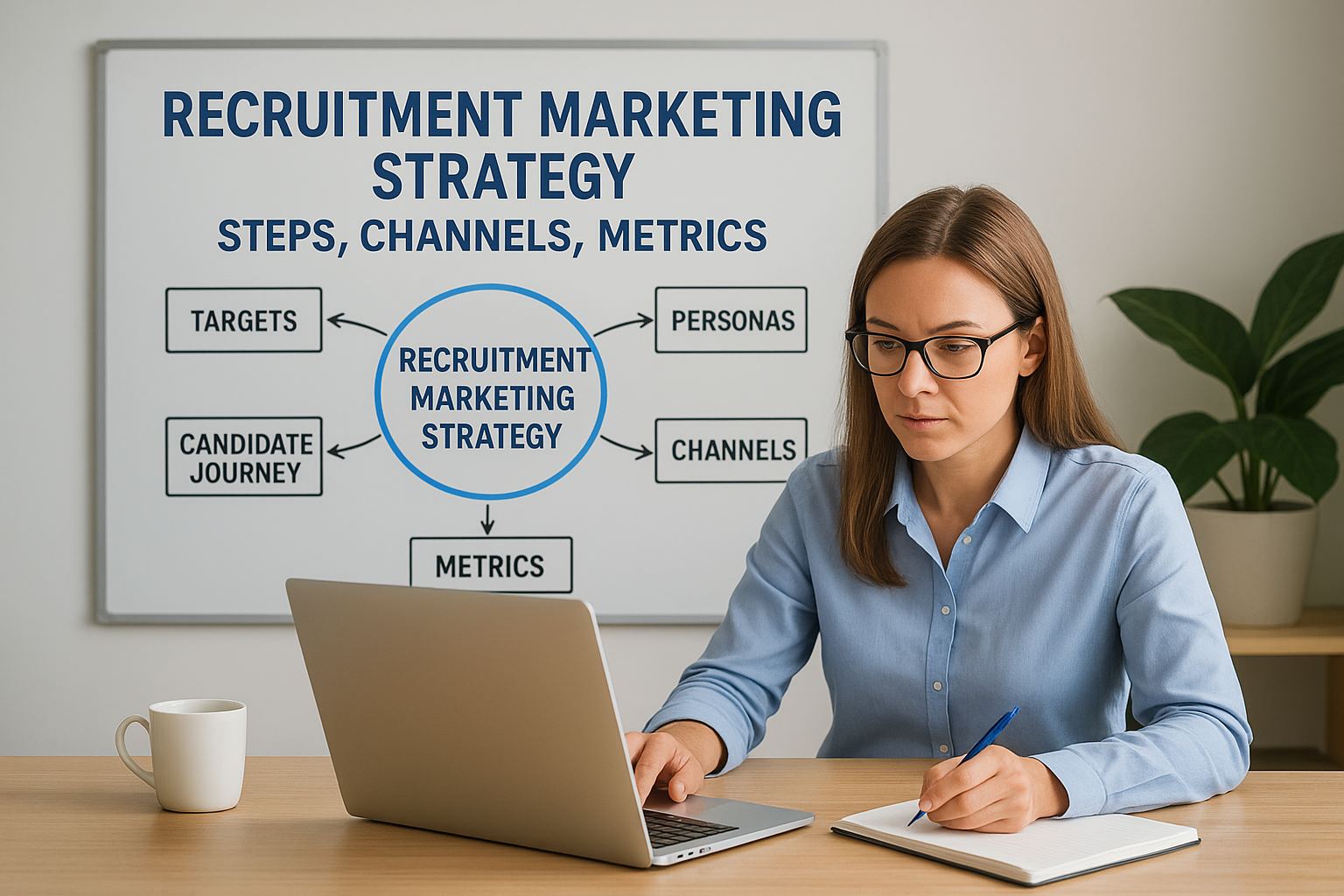
Posting a job and waiting for applications stopped working years ago. The companies consistently hiring strong IT talent, the ones not scrambling to fill the same roles every quarter, are treating recruitment like what it actually is: a marketing problem. A well-built recruitment marketing strategy gives you a repeatable system for attracting, engaging, and converting candidates before a role even opens.
At Aristek, we’ve placed thousands of IT professionals across healthcare, finance, manufacturing, and government. Our talent network includes over 100,000 vetted candidates, and maintaining that pipeline didn’t happen by accident. It happened because we approach talent acquisition the same way a growth team approaches revenue, with defined channels, measurable outcomes, and constant iteration.
This guide breaks down how to build a recruitment marketing strategy from scratch. You’ll get the specific steps to define your employer brand, choose the right channels, create content that resonates with technical candidates, and track metrics that actually matter. Whether you’re an IT Director filling a critical infrastructure role or a VP of Operations scaling a team, this framework gives you a clear path from planning to execution.
What recruitment marketing strategy means in 2026
A recruitment marketing strategy is a systematic plan for attracting qualified candidates using the same principles that drive customer acquisition: audience targeting, branded messaging, multi-channel distribution, and measurable conversion funnels. In 2026, the talent market, especially in IT, has made this approach non-negotiable. Passive candidates now make up the majority of the workforce, meaning the people you want most are not actively browsing job boards. You need to reach them where they already are and give them a reason to pay attention before a role is ever posted.
How it differs from traditional recruiting
Traditional recruiting is reactive. A role opens, a job description goes live, and a recruiter starts screening inbound applications. Recruitment marketing flips that model entirely. You build awareness and interest with qualified candidates on a continuous basis, so when a role opens, you already have a warm pipeline ready to contact. The difference is not just tactical. It changes your hiring timelines, reduces cost-per-hire, and raises the overall quality of candidates you bring to final interviews.
Reactive recruiting fills seats. Recruitment marketing builds pipelines.
Treating recruitment as purely transactional also creates compounding costs. Every time a critical role opens with no existing pipeline, you pay more, wait longer, and compete against every other employer posting the same week. A proactive, always-on strategy changes that dynamic by turning your employer brand into a long-term asset rather than a last-minute tool.
The talent market conditions shaping strategy in 2026
The IT sector operates under sustained demand pressure. Cybersecurity, cloud infrastructure, data engineering, and DevOps roles continue to outpace available supply in most U.S. metro markets. Candidates in these disciplines receive multiple outreach messages per week and have developed strong filters against generic job pitches. Your strategy needs to account for high candidate skepticism and short attention windows. A job description alone will not cut through that noise.
Alongside competition, candidate expectations around employer transparency have risen sharply. Before responding to any outreach, candidates research your company. They check LinkedIn pages, review aggregators, employee testimonials, and your career site. If your employer brand is inconsistent or absent across those surfaces, you lose candidates before a single conversation starts. This is why strategy-level thinking matters more than individual job postings or one-off campaigns.
What a modern recruitment marketing strategy actually includes
Most organizations treat recruitment marketing as a single activity, usually employer branding or job board advertising. In practice, a complete strategy spans six interconnected layers:

| Layer | What it covers |
|---|---|
| Employer value proposition (EVP) | The specific, credible reasons a candidate should choose you over a competitor |
| Candidate personas | Detailed profiles of your target roles, including where candidates spend time and what objections they raise |
| Channel mix | A deliberate selection of platforms matched to your personas, not a default set |
| Content plan | Role-specific, culture, and technical content mapped to different stages of candidate awareness |
| Nurture sequences | Touchpoints that keep warm candidates engaged between active hiring cycles |
| Measurement framework | KPIs tied to each funnel stage so you can find drop-off and optimize spend |
Each layer feeds the next, and gaps in one layer degrade performance across the rest. A strong EVP with no distribution channel produces no awareness. A high-traffic career page with no nurture system loses candidates who were not ready to apply on day one. The sections that follow walk you through each layer in order, giving you a working framework you can implement against your actual hiring goals.
Step 1. Set hiring goals and success criteria
Your recruitment marketing strategy only performs as well as the goals you feed into it. Before you write a single piece of content or choose a channel, you need to know exactly what you’re trying to achieve and how you’ll measure it. Vague goals like "attract better candidates" or "reduce time-to-fill" without numbers attached are not goals. They’re intentions, and intentions don’t drive decisions.
Translate business goals into hiring targets
Start with your organization’s actual business plan. If your company plans to launch a new infrastructure modernization project in Q3, that translates into specific headcount needs: how many roles, at what skill level, by what date. Work backward from that date to establish when candidates need to be in final interviews, when they need to enter your pipeline, and when your awareness campaigns need to start running.
Your hiring deadlines should drive your campaign calendar, not the other way around.
Use this template to map each role to a concrete target:
| Role | # of Hires | Hire-By Date | Pipeline Start Date | Campaign Launch Date |
|---|---|---|---|---|
| Cloud Infrastructure Engineer | 3 | July 1 | May 15 | April 15 |
| Cybersecurity Analyst | 2 | August 1 | June 15 | May 15 |
| Data Engineer | 1 | July 15 | June 1 | May 1 |
Fill this out for every active role before you invest time or budget in any channel. If you skip this step, your campaigns will run without a deadline, and campaigns without deadlines tend to drift.
Define what success looks like before you start
Most teams measure recruitment success after the fact, which means they discover failures too late to fix them. Setting KPIs upfront, tied to each stage of your funnel, gives you early warning signals when a campaign is underperforming before you’ve burned through your budget or missed a hire date.
For each role or campaign, define targets across four measurement layers: awareness, engagement, conversion, and quality. Here is a practical starting framework:
- Awareness: Job post impressions, career page visits, LinkedIn follower growth
- Engagement: Application start rate, content click-through rate, recruiter response rate
- Conversion: Application completion rate, interview-to-offer ratio, offer acceptance rate
- Quality: Hiring manager satisfaction score, 90-day retention rate, time-to-productivity
These numbers give you a complete picture of where your pipeline is healthy and where it breaks down. Without them, you are optimizing blind.
Step 2. Define candidate personas and your EVP
Most recruitment marketing strategy failures trace back to one root cause: messaging built for a generic candidate rather than a specific person. Candidate personas and your employer value proposition (EVP) are the two inputs that shape every piece of content, every channel choice, and every campaign message you create. Get them right here, and the rest of the build becomes faster and more focused. Skip them, and you will consistently attract the wrong candidates or fail to convert the right ones.
Build candidate personas that reflect real technical roles
A candidate persona is a detailed profile of the person you are trying to hire, built from real data rather than assumptions. Talk directly to your best current employees in each role category and ask them where they spend time online, what made them leave their last job, and what made them choose you. Cross that with any application data or recruiter notes you already have. The output should be specific enough that you could write a LinkedIn message to that exact person without it sounding generic.
The more precisely you define who you are targeting, the less budget you waste reaching people who will never convert.
Use this template to build one persona per role category:
| Field | Example: Cloud Infrastructure Engineer |
|---|---|
| Job title(s) targeted | Cloud Engineer, Infrastructure Architect, DevOps Engineer |
| Years of experience | 5-10 years |
| Primary motivation to move | Stagnant stack, lack of remote flexibility, limited project scope |
| Key objections to new roles | Unclear growth path, contract vs. permanent ambiguity |
| Where they spend time | LinkedIn, GitHub, AWS re:Post community forums |
| Content they respond to | Technical case studies, team culture videos, honest comp ranges |
Build a separate version of this table for each major role type you hire. If you recruit across cybersecurity, data engineering, and cloud infrastructure, each group has different motivations and different objections. Treating them as one audience produces content that speaks to none of them well.
Craft an EVP that candidates actually believe
Your EVP is the specific, credible answer to the question every candidate asks: "Why should I work here instead of somewhere else?" It is not a tagline. A strong EVP names concrete differentiators, such as project variety, compensation structure, remote policy, or growth timeline, and backs each claim with evidence a candidate can verify independently. Vague statements like "we invest in our people" carry no weight. Tie every EVP claim to something a candidate can confirm by talking to your current team or reading a public review.
Step 3. Map the funnel and candidate journey
Before you build any campaign, you need to understand how a candidate moves from complete stranger to accepted offer. This map tells you what content to create, what channels to use at each stage, and where your current process is losing people. Without it, your recruitment marketing strategy operates without a flow, and you end up pushing budget into awareness while your application completion rate quietly bleeds candidates you already earned.
The five stages of the candidate funnel
Every candidate moves through a predictable sequence, regardless of role or seniority. Each stage requires a different message and a different action from your team. Trying to push someone from first awareness directly to application skips the trust-building steps that technical candidates in particular rely on before they engage.

Candidates who skip stages don’t vanish, they just find a competitor who gave them the right information at the right time.
Use this table to map what each stage means, what the candidate needs, and what your team provides:
| Stage | What the candidate is doing | What they need from you | Your output |
|---|---|---|---|
| Unaware | Not thinking about a move | A reason to notice you | Thought leadership, LinkedIn posts, community presence |
| Aware | Knows your company exists | Proof you’re worth learning about | Career page, employer reviews, team content |
| Interested | Actively researching | Role details, culture signals, honest compensation | Job descriptions, employee spotlights, comp ranges |
| Considering | Comparing you to other options | Differentiation and social proof | Case studies, recruiter outreach, response speed |
| Applying | Ready to move forward | A fast, low-friction process | Streamlined application, clear next steps, quick follow-up |
Identify where candidates drop off
Once you have the funnel mapped, audit your current data to find the stages where candidates exit without converting. Pull your career site analytics and look at the ratio of page visits to application starts. Check your applicant tracking system for application completion rates. If your career page gets solid traffic but your application start rate sits below 10 percent, the problem lives in the "Interested" stage, and the fix is content and clarity, not more ad spend.
Walk this audit process for each active role type you hire. Document the specific drop point for each role, then build your content and channel choices in the next step directly around fixing those gaps. This turns your funnel map from a planning exercise into a diagnostic tool you use throughout the hiring cycle.
Step 4. Pick channels that match your personas
Channel selection is where many recruitment marketing strategy efforts break down. Most teams default to the same three or four platforms they have always used, regardless of whether their target candidates actually spend time there. Your personas from Step 2 already contain the answer to which channels you should use. Now you match those answers to a deliberate, prioritized channel mix instead of spreading budget across every available platform.
Match channel to candidate behavior, not default assumptions
Every channel you choose should trace directly back to a specific behavior your candidate persona exhibits. If your Cloud Infrastructure Engineers spend time on GitHub and AWS community forums, that is where your awareness content belongs, not just LinkedIn. If your target cybersecurity candidates attend virtual conferences and read technical newsletters, those are your paid placement priorities. Defaulting to LinkedIn alone because it is the standard recruiting platform means you are competing in the most crowded space instead of finding candidates where competition is lower.

Showing up where your competitors are not is often more effective than outspending them where everyone already advertises.
Use this channel-matching table as a starting framework and adjust it to reflect what your own persona research revealed:
| Candidate Type | High-Priority Channels | Secondary Channels |
|---|---|---|
| Cloud / DevOps Engineer | GitHub, AWS re:Post, LinkedIn | YouTube tutorials, Slack communities |
| Cybersecurity Analyst | LinkedIn, SANS forums, security podcasts | Reddit (netsec), targeted newsletters |
| Data Engineer | LinkedIn, Kaggle, dbt community Slack | Medium technical blogs, GitHub |
| IT Infrastructure Manager | LinkedIn, industry associations | Direct recruiter outreach, referral programs |
Allocate budget by funnel stage, not just by platform
Channels serve different purposes at different funnel stages, and your budget allocation should reflect that. Awareness-stage channels like LinkedIn Sponsored Content or programmatic display expose your employer brand to candidates who do not know you yet. Consideration-stage channels like retargeting ads and email nurture sequences re-engage candidates who visited your career page but did not apply. Splitting budget without assigning each channel to a funnel stage means you cannot diagnose what is actually working.
A practical starting split for most IT hiring programs is 60 percent toward consideration and conversion channels where warm audiences already exist, and 40 percent toward awareness channels building new pipeline. Adjust that ratio based on your funnel audit from Step 3. If your drop-off is at the awareness stage, shift more toward top-of-funnel. If you have traffic but low application starts, your budget belongs in nurture and conversion, not more awareness spend.
Step 5. Build campaigns and content that converts
Your channel mix and personas mean nothing without content that actually moves candidates forward. Most recruitment content fails at the campaign level, not because the employer brand is weak, but because the content does not match what the candidate needs at that specific stage of the funnel. This is where your recruitment marketing strategy either earns attention or loses it permanently.
Match content format to funnel stage
Every piece of content you create should serve a single stage of the candidate funnel, not try to do everything at once. An awareness post on LinkedIn is not the place to list 14 job requirements. A retargeting ad aimed at candidates who already visited your career page is not the place for generic brand messaging. When you match format and message to stage, your content performs a specific job rather than a vague one.
The candidates most worth reaching will ignore content that feels like it was built for someone else.
Use this table to assign the right content type to each funnel stage:
| Funnel Stage | Content Type | Example |
|---|---|---|
| Unaware | Thought leadership, short-form video | "What a day in our cloud team actually looks like" |
| Aware | Employee spotlights, culture posts | Written Q&A with a senior engineer on career growth |
| Interested | Role-specific content, honest comp posts | "What we pay Cloud Engineers and why" |
| Considering | Social proof, recruiter outreach copy | Candidate testimonials, direct LinkedIn messages |
| Applying | Clear CTAs, streamlined application prompts | "Apply in under 10 minutes, here is exactly what to expect" |
Use a campaign brief to keep execution on track
Before you build any campaign, write a one-page brief that forces alignment on audience, message, channel, and goal. This prevents the most common execution failure: a team that has different assumptions about who the campaign is for or what it should accomplish. Fill out this template for every campaign you run:
Campaign Brief Template

Role targeted: [Job title]
Candidate persona: [Persona name from Step 2]
Funnel stage: [Unaware / Aware / Interested / Considering / Applying]
Core message: [One sentence: what you want the candidate to believe after seeing this]
Channel: [Where this content runs]
Format: [Video / Post / Email / Ad]
Call to action: [Exactly what you want the candidate to do next]
Success metric: [Click-through rate / Application starts / Response rate]
Campaign window: [Start date to end date]
Running every campaign through this brief keeps your content focused and gives you a reference point when you review performance data in Step 6.
Step 6. Track metrics, report, and optimize
Your recruitment marketing strategy does not improve on its own. It improves when you review real data on a fixed schedule and make specific adjustments based on what that data shows. Most teams collect metrics but never build a reporting rhythm that forces decisions. This step closes that gap by giving you a structure for regular review and a template that turns numbers into action.
Build a reporting cadence that drives decisions
Set up three reporting intervals: weekly, monthly, and quarterly. Each serves a different purpose and answers a different question.
Weekly reports cover active campaign performance only. Look at click-through rates, application starts, and recruiter response rates for any live campaigns. If a channel is underperforming against the target you set in Step 1, adjust the message or pause the spend before you waste the full budget. Weekly reviews keep small problems from compounding into missed hire dates.
The teams that hit their hiring targets consistently are the ones reviewing data weekly, not after the role closes.
Monthly reports zoom out to funnel health. Compare application completion rates and interview-to-offer ratios against your baseline from the previous month. If application completions dropped, check whether a form changed or a page broke. Funnel drops almost always have a specific cause, and monthly data surfaces them before they affect multiple hiring cycles.
Quarterly reports evaluate channel ROI and overall strategy performance. Look at cost-per-hire and 90-day retention rates by role type. These numbers tell you whether the candidates your campaigns attract are actually the right fit, not just the highest volume.
Use a single reporting template every cycle
Switching between different report formats every month makes it harder to spot trends. Use the same template every reporting cycle so you can compare data side by side without rebuilding the structure each time.
Recruitment Marketing Report Template

Reporting period: [Month / Quarter]
Role(s) covered: [Job titles]

Awareness
- Career page visits: [#]
- Job post impressions: [#]

Engagement
- Application start rate: [%]
- Content click-through rate: [%]

Conversion
- Application completion rate: [%]
- Offer acceptance rate: [%]

Quality
- Hiring manager satisfaction score: [1-10]
- 90-day retention rate: [%]

Top-performing channel this period: [Channel name]
Biggest drop-off point: [Funnel stage]
One change to make next cycle: [Specific action]
Fill out the final three rows every single cycle. Naming one change to make next cycle turns your report from a recap into a decision, which is the only version of reporting that actually improves results.

Next steps
You now have a complete framework for building a recruitment marketing strategy that runs from goal-setting through continuous optimization. The six steps in this guide build on each other deliberately: your personas shape your channel choices, your funnel map directs your content decisions, and your reporting cadence turns data into specific improvements each cycle. None of these steps work in isolation, and skipping one will degrade the steps that follow.
Start with Step 1 this week. Pull your current open roles, assign a hire-by date to each one, and work backward to set your campaign launch dates. That single exercise will reveal gaps in your current approach faster than any audit tool. If you need a partner who combines technical talent placement with a proven pipeline methodology, Aristek works directly with IT decision-makers to accelerate hiring without the guesswork. Talk to our team about your current hiring goals and get a response within minutes.


Leave a Reply