


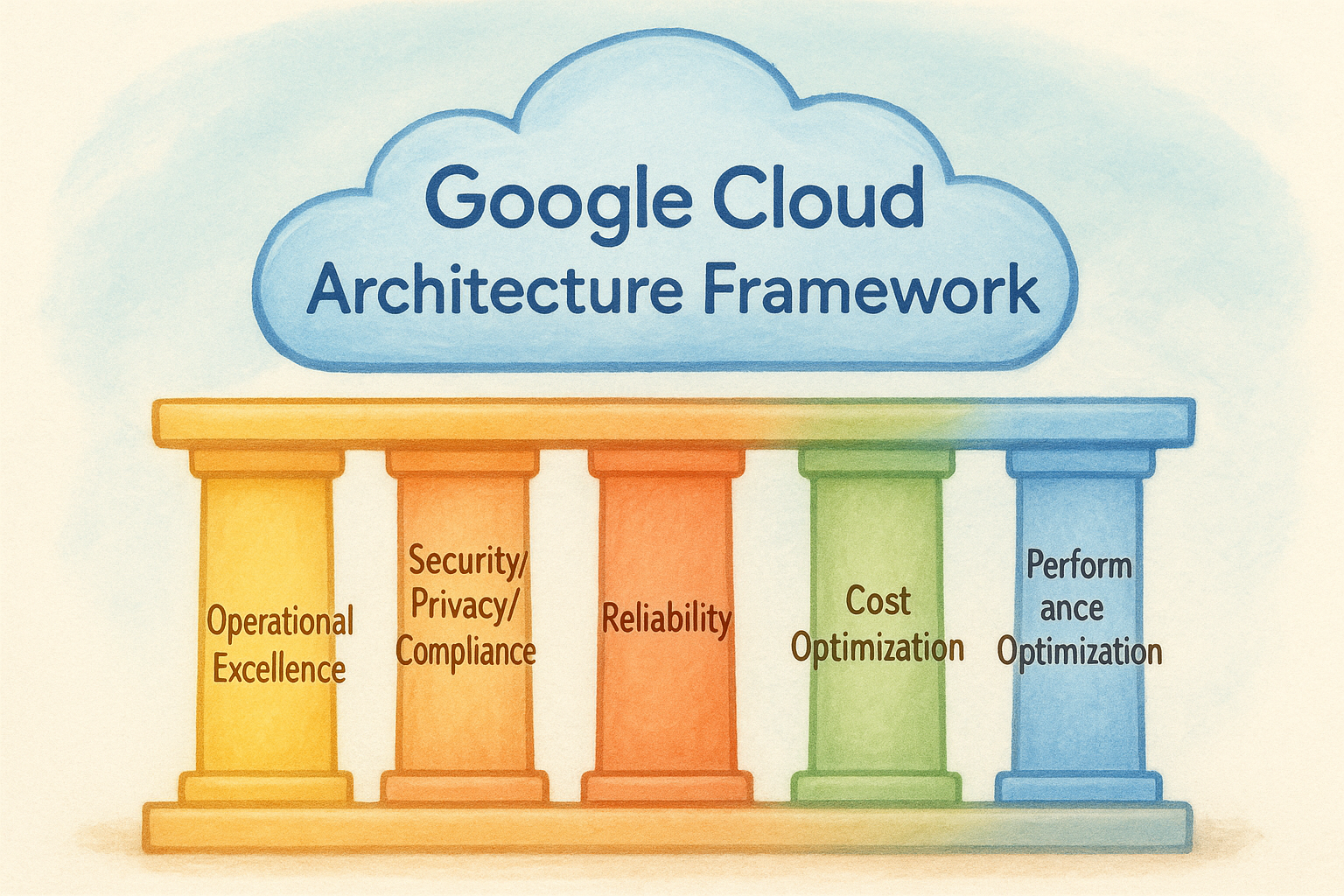
If you are evaluating a workload on Google Cloud, or trying to figure out why a system that looked fine on paper keeps failing audits and cost reviews, you need a structured way to judge it. The google cloud architecture framework is Google’s official set of design principles and recommendations for building systems that hold up under real production pressure, not just demo traffic. It gives architects and engineering teams a common vocabulary for talking about tradeoffs instead of arguing from gut feel.
This guide breaks down what the framework actually says, without the marketing fluff Google wraps around it. You will get a plain explanation of each pillar, from reliability and security to cost optimization and operational excellence, and how they interact when you try to optimize for one at the expense of another. We also cover the design guidance Google publishes for specific workload types, so you can apply the framework instead of just reading about it.
We wrote this because our consultants use frameworks like this one daily when staffing and stabilizing infrastructure for clients across healthcare, finance, and manufacturing. Whether you are building new on GCP or auditing an existing environment, this article gives you the best practices and a practical checklist to evaluate your architecture against Google’s own standards.
Why the framework matters for your cloud strategy
Most teams don’t set out to build a fragile cloud environment. It happens gradually, one deadline-driven decision at a time, until a system that passed every sprint demo starts failing under real traffic or a compliance review. The google cloud architecture framework exists because Google has watched this pattern repeat across thousands of customer environments and built a checklist to catch it before it becomes a production incident. Skipping it doesn’t save time. It just moves the cost of bad decisions from design time to incident response, which is always more expensive.
What happens without a shared framework
Without a common reference point, every engineer on your team optimizes for whatever they personally value most. One person prioritizes raw performance, another chases the lowest possible bill, and a third quietly builds in redundancy nobody asked for because it feels safer. None of them are wrong, but none of them are working from the same design principles, so the resulting architecture is a patchwork of individual preferences rather than a coherent system. Google’s framework fixes this by giving every stakeholder, from the security lead to the finance team, the same set of pillars to argue from.
Aligning teams around tradeoffs
Google’s own documentation is explicit that architecture is a series of tradeoffs, not a search for a single perfect answer, and you can read their full breakdown in the Google Cloud Architecture Framework. A workload tuned purely for cost will eventually compromise reliability. One tuned purely for security will slow down every release cycle. The framework doesn’t tell you which pillar wins. It gives you the vocabulary to make that tradeoff on purpose, with your leadership team’s eyes open, instead of by accident six months into production.
A cloud architecture that nobody consciously designed is still a design decision, just an unaccountable one.
Consider what a structured cloud strategy actually changes day to day. It’s the difference between a postmortem that says "we should have caught this" and an architecture review that catches it three weeks earlier, before a single customer noticed. The table below captures the pattern we see most often in client environments before and after adopting the framework as a review standard.
| Without the framework | With the framework applied |
|---|---|
| Decisions made ad hoc, per engineer | Decisions evaluated against shared pillars |
| Cost discovered after the invoice arrives | Cost modeled before deployment |
| Security bolted on after an incident | Security reviewed at design time |
| Reliability tested by outages | Reliability tested by design review |
Teams that adopt this discipline early don’t move slower. They move faster later, because they stop re-architecting the same broken pattern every quarter. That’s the real payoff of the framework: it’s not a compliance checkbox, it’s a way to make your cloud strategy durable enough to survive the next round of scale, audits, or leadership turnover without falling apart.
The five pillars of the framework explained
Google’s google cloud architecture framework rests on five pillars, and each one asks a different question about your system. None of them is optional, and none of them is more important than the others in the abstract. What changes is which pillar takes priority for a specific workload, at a specific stage of its life. A payments system leans hard on reliability and security. An internal analytics dashboard can tolerate more downtime in exchange for lower cost. Knowing the pillars by name means nothing if you can’t rank them for your own workload.
The five pillars at a glance
Each pillar comes with its own checklist in Google’s documentation, but the core question behind each one is straightforward enough to memorize.

| Pillar | Core question it answers |
|---|---|
| Operational excellence | Can your team run this system without heroics? |
| Security, privacy, and compliance | Is data protected at rest, in transit, and under audit? |
| Reliability | Does the system recover on its own when something breaks? |
| Cost optimization | Are you paying for capacity you actually use? |
| Performance optimization | Does the system scale without a rewrite? |
Taken together, these design principles cover the full lifecycle of a workload, from the first architecture diagram through years of production traffic and every migration in between.
Where the pillars conflict
Pillars pull against each other constantly, and pretending otherwise is where most architecture reviews go wrong. Adding redundant compute regions improves reliability but raises cost. Locking down every network path improves security but slows deployment velocity. Caching aggressively improves performance but can violate compliance requirements around data freshness or retention.
Every architecture decision trades strength in one pillar for weakness in another, and the framework’s job is to make that trade visible.
Specific workload guidance published by Google, covering AI and ML systems, data platforms, and hybrid environments in the Google Cloud Architecture Center, shows how these tradeoffs shift by use case. Reading the pillars in isolation gets you nowhere. Reading them against your actual workload is where the framework earns its keep.
How to apply the framework to your architecture
Knowing the five pillars is worthless if you never run a workload through them. Applying the google cloud architecture framework means treating it as a recurring review process, not a one-time document you read before a project kicks off. Google’s own guidance recommends scoring each workload against every pillar, then documenting which tradeoffs you accepted and why, so the next engineer who touches the system understands the reasoning instead of just inheriting the result.
Start with a workload assessment
Before you touch infrastructure, map your current architecture against the five pillars honestly. Most teams skip this step because it feels slow, but it’s the step that catches expensive mistakes before they ship.
- List every workload and its business criticality
- Score each one on operational excellence, security, reliability, cost, and performance (1 to 5 is enough)
- Flag any pillar scoring below 3 as a design risk, not a backlog item
- Assign an owner to each flagged risk, not just a ticket
A pillar score nobody owns is a risk nobody fixes.
Build review checkpoints into your delivery process
A framework applied once at launch decays fast. Bake pillar reviews into your existing change management process instead of treating them as a separate audit. That means every architecture decision record references at least one pillar explicitly, and every major release includes a short pillar retrospective: what did we trade, and did we mean to?
Google’s Architecture Framework recommendations include workload-specific checklists for AI systems, data analytics platforms, and hybrid deployments. Use those checklists as your review template rather than writing your own from scratch. Consistency across reviews matters more than customizing the format.
Translate pillar scores into roadmap priorities
Once you have scores, resist the urge to fix everything at once. Rank fixes by business impact first, not by which pillar feels most urgent to your engineering team. A reliability gap in a customer-facing payments flow outranks a cost inefficiency in an internal reporting tool, even if the cost fix is cheaper to implement. Treating the framework as a prioritization tool, not just a scoring rubric, is what separates teams that actually improve their architecture from teams that produce a report nobody revisits.
Common pitfalls when adopting the framework
Teams rarely fail at the framework because they misunderstand the pillars. They fail because they apply it inconsistently, or treat it as a one-time exercise instead of a habit. The google cloud architecture framework only works if it gets used the same way every time, by every team, on every workload that matters.

Treating it as a checkbox exercise
The most common mistake is running one pillar review before launch and never touching it again. A workload that scored well on reliability at launch can drift into risk within a year as traffic patterns change, dependencies get added, and the original architects move to other projects. Documentation ages badly if nobody owns keeping it current. Build a recurring cadence, quarterly at minimum for critical workloads, or the review becomes a historical artifact instead of a working tool.
Letting one pillar dominate every decision
Security teams over-index on lockdown. Finance teams over-index on cost. Engineering teams over-index on performance. Each group defends its pillar in isolation, and nobody steps back to weigh the tradeoff against the others. This produces architectures that are excellent on one axis and quietly broken on the rest.
A pillar optimized in isolation is a pillar that’s actually failing the other four.
Skipping the documentation step
Scoring a workload against the five pillars and then not writing down why you accepted certain tradeoffs erases the whole point of the exercise. Six months later, nobody remembers whether a design gap was a deliberate tradeoff or an oversight, so every review starts from zero.
Applying generic guidance to a specialized workload
Google’s workload-specific guidance exists precisely because a healthcare data platform and an internal reporting dashboard don’t carry the same risk profile. Applying the same generic pillar weights to both produces a compliant-looking review that misses the actual risk.
Common pitfalls, side by side:
| Pitfall | Consequence |
|---|---|
| One-time review, never repeated | Architecture drifts silently |
| Single pillar dominates decisions | Other pillars quietly degrade |
| No documentation of tradeoffs | Repeated mistakes, no institutional memory |
| Generic checklist, ignores workload type | Misses sector-specific risk entirely |
Each of these pitfalls is fixable with process, not more tooling. The teams that avoid them simply treat the framework as ongoing discipline rather than paperwork.
Getting expert help with implementation
Reading the framework is one thing. Running it consistently across dozens of workloads, while also shipping features and keeping the lights on, is another. Most internal teams don’t lack the willingness to apply the google cloud architecture framework, they lack the bandwidth to make it a habit rather than a one-time project. That’s usually the point where a client calls us, not because they misunderstood the pillars, but because nobody on staff had the hours to own the recurring review.
When to bring in outside expertise
Outside help earns its cost fastest in three situations: a migration under a hard deadline, a compliance audit that exposed gaps nobody caught internally, or a team that’s grown faster than its architecture practices have matured. In each case, an experienced partner can run a full pillar assessment in weeks instead of the months it takes an already-stretched internal team to get to it.
The fastest way to lose the framework’s value is to assign it to whoever has spare time this sprint.
What to look for in a partner
Not every consulting firm that name-drops Google Cloud actually applies the framework with any rigor. Before you sign anything, check for:
- Direct experience staffing or managing workloads in your specific industry, not just general cloud experience
- A documented review process tied to the five pillars, not a generic security audit relabeled
- Engineers who can explain tradeoffs in plain language to your leadership team, not just your infrastructure staff
- A track record of ongoing support, since a one-time review repeats the checkbox mistake covered earlier
Where Aristek fits
Aristek’s consultants work through this exact process daily, pairing IT talent solutions with hands-on infrastructure work for clients in healthcare, finance, and manufacturing, sectors where a missed pillar isn’t a minor gap, it’s a compliance finding. Because we handle both the staffing and the managed services side, we can score your architecture against the framework and then actually place the engineers needed to close the gaps, instead of handing you a report and walking away.

Building a stronger foundation on Google Cloud
The google cloud architecture framework isn’t a document you read once and file away. It’s a discipline you build into every design review, every migration, and every quarter you spend running production workloads. The five pillars won’t rank themselves for you, and no checklist replaces the judgment of a team that actually owns the tradeoffs it accepts. What separates architectures that survive scale from ones that collapse under it is whether someone kept applying the framework after launch day, not just before it.
If your team knows the gaps in your current architecture but doesn’t have the hours to close them, that’s exactly where an outside partner earns its keep. Aristek’s consultants score workloads against these pillars daily and bring the engineers needed to fix what the review finds. Talk to our team about auditing your architecture before the next incident forces the conversation.


Leave a Reply