


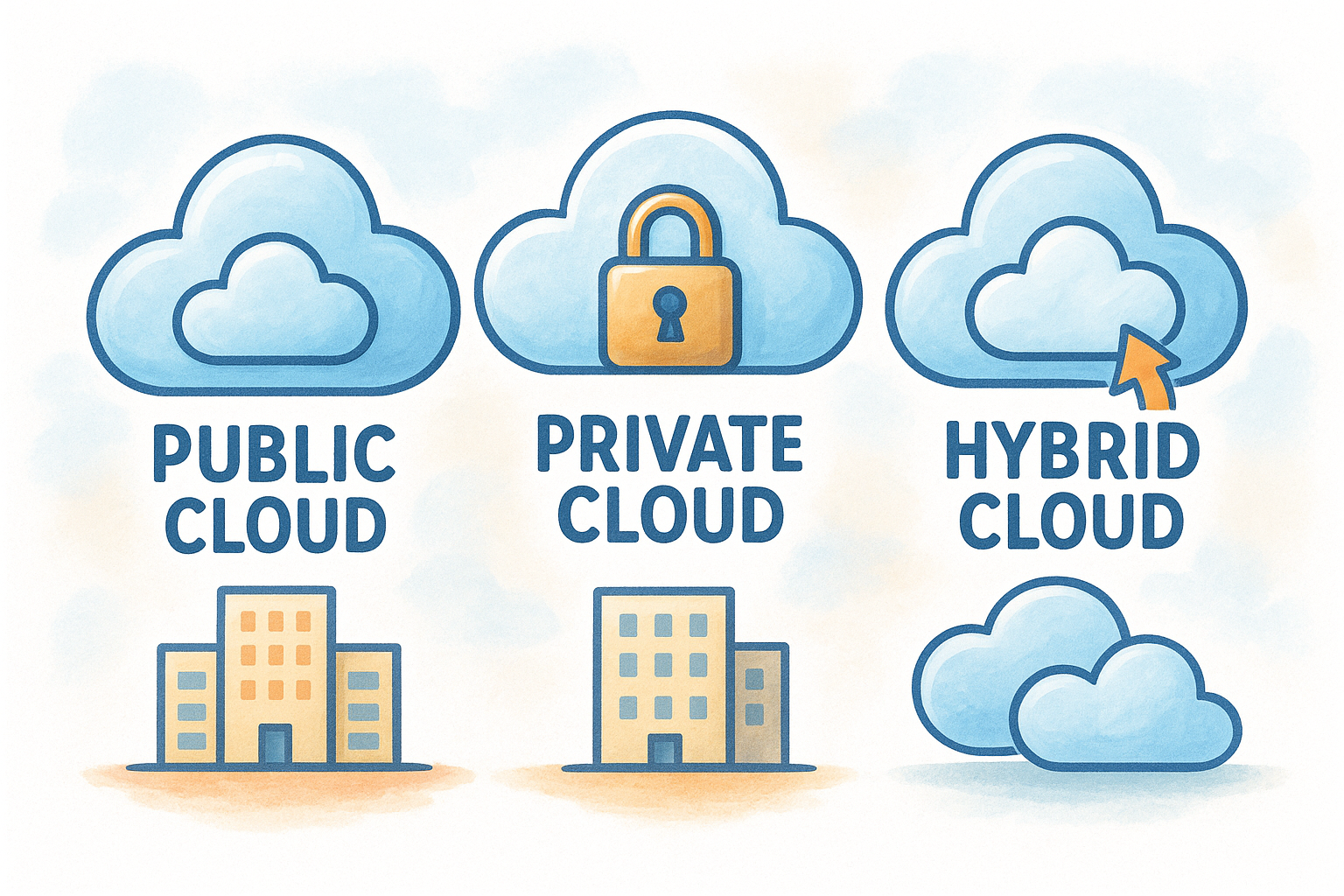
Choosing between public cloud vs private cloud vs hybrid cloud isn’t just a technical decision, it’s a business strategy call that affects your security posture, operating costs, and how fast you can scale. Yet many organizations rush into a deployment model based on vendor pitches or industry buzz, only to find themselves locked into infrastructure that doesn’t match how they actually operate.
Each cloud model comes with real trade-offs. Public clouds offer elastic resources without heavy capital investment. Private clouds give you tighter control over data and compliance. Hybrid clouds attempt to combine both, but introduce their own complexity. The right choice depends on your workloads, your regulatory environment, and where your business is headed, not on a one-size-fits-all recommendation. Understanding these differences at a practical level is what separates a smart infrastructure investment from an expensive corrective project two years down the road.
At Aristek, we help organizations build and manage technical infrastructure that aligns with their actual business requirements, from staffing the right cloud engineers to providing managed IT services that keep environments stable and secure. This guide breaks down all three cloud models across security, cost, control, and scalability so you can make a grounded decision about which approach fits your organization best.
Why choosing the right cloud model matters
Your cloud infrastructure decision shapes every downstream technology investment you make. Choosing a model that doesn’t align with your workloads means you’ll eventually pay twice: once to implement and once to re-architect. The differences between public cloud vs private cloud vs hybrid cloud are significant enough that a wrong fit can slow development cycles, inflate costs, or create compliance gaps that take months to close.
The real cost isn’t just compute and storage
Most IT leaders look at the monthly invoice and assume that’s the full picture. It isn’t. Hidden costs pile up quickly when your cloud model forces workarounds, such as moving data between environments you didn’t plan for, licensing software across incompatible platforms, or paying for capacity you can’t use because of latency or security restrictions. Capital expenditure vs. operating expenditure tradeoffs also vary dramatically between models. Public cloud shifts spending to OpEx, which helps cash flow but can create unpredictable bills at scale. Private cloud requires upfront hardware investment but gives you more predictable costs over a multi-year horizon.
The right cloud model doesn’t just reduce costs, it aligns your spending with how your business actually consumes resources.
Security requirements vary by workload and industry
Not every workload carries the same risk profile, and your security posture needs to reflect that reality. A healthcare organization storing protected health information under HIPAA has fundamentally different requirements than a SaaS startup running marketing analytics. Regulated industries like finance, healthcare, and government face strict data residency and sovereignty rules that public cloud shared-tenant environments may not satisfy without significant additional configuration. Choosing the wrong model in these contexts doesn’t just create technical debt, it creates legal exposure.
Your compliance team should be part of this conversation before any infrastructure contracts are signed. Audit trails, encryption standards, and access control policies all behave differently across deployment models, and discovering a compliance gap after go-live is a far more expensive lesson than doing the architecture work upfront.
Scalability and control trade off against each other
Scalability looks different depending on whether you’re handling variable consumer demand or steady, predictable internal workloads. Public cloud excels when you need to provision resources quickly without planning around physical capacity. But that flexibility comes at the cost of direct control over the underlying infrastructure. If your engineering team needs to configure network topology, manage hypervisors, or enforce hardware-level isolation, public cloud abstracts away exactly the controls you need.
Organizations that commit to a cloud model without mapping their actual workload requirements tend to end up managing operational exceptions rather than running a clean, consistent environment. The more exceptions you build in, the more overhead accumulates, and that overhead compounds as your footprint grows. Getting the model right at the start is far less disruptive than trying to migrate workloads after your teams have already built processes around the wrong architecture.
What public cloud is and when it fits
Public cloud is a computing model where a third-party provider, such as AWS, Microsoft Azure, or Google Cloud, owns and operates the underlying infrastructure and makes it available to multiple organizations over the internet. You share physical hardware, networking, and storage with other customers, though your data and workloads remain logically isolated. This shared-tenant model is what enables providers to offer on-demand resource provisioning at a scale no single organization could replicate independently.
Public cloud removes the burden of hardware ownership, but that tradeoff means you accept less direct control over the underlying infrastructure.
The cost structure and scalability of public cloud
When you compare public cloud vs private cloud vs hybrid cloud, the public model’s strongest advantage is its pay-as-you-go pricing. You pay for compute, storage, and networking based on actual consumption rather than forecasted capacity, which makes public cloud attractive for organizations that experience variable or unpredictable demand, such as e-commerce platforms during seasonal peaks or SaaS companies onboarding large customer cohorts. You can provision hundreds of virtual machines in minutes and shut them down just as fast, without a capital expenditure commitment.
That flexibility comes with a caveat: costs can scale unexpectedly if you don’t build your workloads with cost governance in mind. Organizations that treat public cloud like unlimited capacity often find their monthly bills climbing faster than anticipated. Tagging resources, setting budget alerts, and auditing unused capacity regularly are baseline practices that keep public cloud costs predictable.
When public cloud fits your workloads
Public cloud is the right fit when your workloads don’t carry strict data residency requirements and your team needs to move quickly without managing physical infrastructure. These categories tend to perform well in public cloud environments:

- Development and testing environments that need rapid provisioning and teardown
- Customer-facing web applications that require geographic distribution and built-in redundancy
- Data analytics pipelines that process variable data volumes
- Collaboration tools and productivity software with broad user access needs
Each of these workloads benefits from managed services, such as databases, machine learning tools, and content delivery networks, without requiring your team to build and maintain the underlying systems internally.
What private cloud is and when it fits
Private cloud is a computing model where the underlying infrastructure is dedicated exclusively to your organization, whether hosted on-premises in your own data center or through a third-party provider on hardware that isn’t shared with other tenants. Unlike the shared-tenant environment of public cloud, private cloud gives you direct control over hardware configuration, network topology, and data handling policies. That level of control comes with a corresponding investment in capital and operations, but for many organizations it’s the only model that satisfies their compliance, security, or performance requirements without compromise.
Private cloud isn’t about avoiding modern infrastructure; it’s about owning the environment that powers your most sensitive workloads.
The cost structure and performance of private cloud
Building or leasing a private cloud requires upfront capital expenditure on hardware, networking, and facilities, or a long-term commitment to a dedicated hosted environment. Unlike the public cloud’s pay-as-you-go pricing, you pay for capacity whether it’s fully utilized or not. That said, when your workloads run at consistent, high utilization, private cloud can cost less per workload over a multi-year horizon than equivalent public cloud resources. Organizations running predictable, resource-intensive applications such as large relational databases or latency-sensitive financial systems often find the economics favor private infrastructure once they model costs beyond the first year.
You also gain performance predictability that shared-tenant environments can’t guarantee. Dedicated compute and network resources mean your workloads aren’t competing for bandwidth or processing power with other organizations, which matters significantly for real-time processing or applications with strict uptime service level agreements.
When private cloud fits your workloads
When evaluating public cloud vs private cloud vs hybrid cloud, private cloud makes the most sense for organizations operating in highly regulated industries or managing data with strict residency and access requirements. Compliance obligations under frameworks like HIPAA, FedRAMP, or PCI-DSS often require hardware-level isolation that shared-tenant environments can’t cleanly satisfy without extensive additional configuration.
These workload types align well with private cloud:
- Mission-critical applications that require guaranteed resource availability and predictable latency
- Sensitive data environments where audit trails and access controls must be enforced at the infrastructure level
- Internal enterprise systems with stable, high-volume usage that doesn’t fluctuate significantly
- Regulated healthcare or financial applications where data residency rules restrict geographic boundaries
What hybrid cloud is and where it fits
Hybrid cloud combines a private cloud environment with one or more public cloud services, connecting them through orchestration and networking so workloads can move between environments based on policy, cost, or capacity needs. Unlike a single-model deployment, hybrid cloud gives you the flexibility to run sensitive workloads on dedicated infrastructure while offloading variable or less-sensitive workloads to public cloud resources. When organizations evaluate public cloud vs private cloud vs hybrid cloud, hybrid often looks like the obvious answer, but it only works well when your team has the operational maturity to manage both environments simultaneously.
Hybrid cloud isn’t a middle ground by default; it’s a deliberate architecture that requires clear workload boundaries and strong integration planning.
How hybrid cloud manages workload distribution
Hybrid cloud operates on the principle that not all workloads carry the same requirements, and routing them accordingly produces better outcomes than forcing everything into a single environment. You keep regulated data, customer records, or latency-sensitive applications on your private infrastructure where you control access and compliance enforcement. At the same time, burst capacity, development environments, and analytics workloads run in public cloud where you pay only for what you consume. The connectivity layer between environments, typically built through VPNs, dedicated interconnects, or cloud-native gateways, is what determines how smoothly this workload separation actually functions in practice.

When hybrid cloud fits your organization
Hybrid cloud fits organizations that have existing private infrastructure they can’t or don’t want to decommission, but need public cloud capabilities to support growth or modernization. It also suits businesses running applications that generate data on-premises but need cloud-scale compute to process that data efficiently.
These situations align well with a hybrid deployment:
- Organizations under regulatory requirements that mandate certain data stays on-premises while other systems can operate in public cloud
- Businesses with seasonal demand spikes that exceed private cloud capacity but return to a baseline that justifies keeping core infrastructure dedicated
- Enterprises migrating to cloud gradually, running legacy and modern systems in parallel during the transition
- Teams building disaster recovery strategies that use public cloud as a failover target for on-premises workloads
How to choose the right model for your workloads
When you work through public cloud vs private cloud vs hybrid cloud options, the decision shouldn’t start with what vendors are promoting or what seems popular in your industry. It starts with an honest inventory of what you’re running, who accesses it, and what the consequences are if that data is compromised or unavailable. The clearest path to the right model runs through your actual workload characteristics, not through a feature comparison sheet.
Your cloud decision is only as good as the workload analysis behind it.
Start with your data sensitivity and compliance requirements
Compliance requirements are often the fastest way to eliminate deployment models from consideration. If your organization handles protected health information, financial transaction records, or government data under frameworks like HIPAA or FedRAMP, you need to determine whether a shared-tenant environment satisfies your obligations without extensive additional configuration. In many cases, sensitive data workloads belong in private or hybrid environments where you control access policies and audit trails at the infrastructure level rather than the application layer.
Before your architecture team commits to a model, bring your compliance and legal stakeholders into the conversation early. That step alone can prevent the costly remediation projects that follow when a compliance gap surfaces after go-live.
Map your workload patterns before committing
Variable demand workloads such as customer-facing applications, development pipelines, or seasonal batch processing align naturally with public cloud because the pay-as-you-go model matches how you actually consume resources. Stable, high-utilization workloads such as core business databases, ERP systems, or real-time transaction processing tend to favor private cloud where dedicated resources deliver both performance predictability and cost efficiency over a multi-year horizon.
If your organization runs both types simultaneously, hybrid cloud may be the right fit, but only when your team has the operational capacity to manage two environments and the integration layer connecting them. Building a straightforward decision matrix that lists each workload alongside its compliance tier, utilization pattern, and performance requirements gives you a concrete foundation for selecting a model rather than defaulting to what a vendor recommends.

Next steps
Working through public cloud vs private cloud vs hybrid cloud requires more than a feature comparison. You need a clear inventory of your workloads, your compliance obligations, and your organization’s capacity to manage whatever environment you deploy. Skipping that groundwork leads to infrastructure decisions that look right on paper but create operational drag within the first year.
Start by documenting your most critical workloads alongside their data sensitivity, utilization patterns, and performance requirements. That analysis gives your architecture team a concrete foundation rather than a vendor-driven recommendation. If your organization lacks the internal expertise to run that assessment or manage the resulting environment, working with an experienced IT partner can close that gap without slowing your timeline.
Aristek works with organizations across healthcare, finance, manufacturing, and enterprise sectors to build and manage infrastructure that fits real business requirements. If you’re ready to make a grounded infrastructure decision, connect with our team and we’ll help you get there.


Leave a Reply